ॐ Namah Shivaya · Sacred essentials for everyday devotion

Arunachala: History & Sacred Landscape
A living temple. A sacred mountain. Many layers of history.
TIRUVANNAMALAI · TAMIL NADU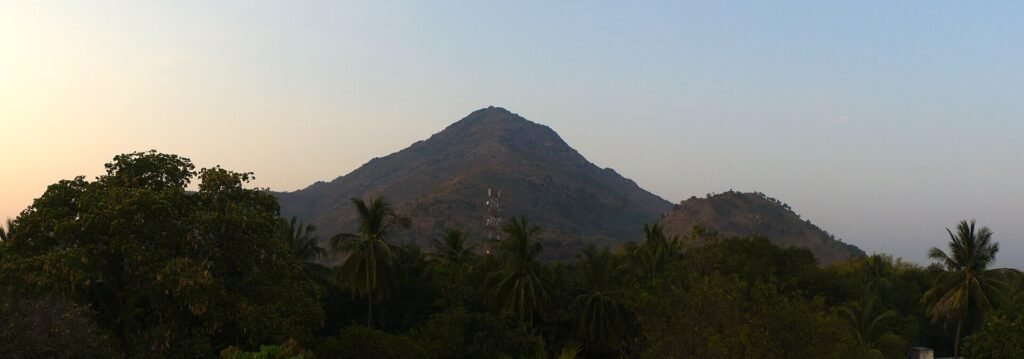
The hill and the temple
For Shiva devotees, Arunachala is revered as the divine presence in the form of a hill. The great Arunachaleswarar Temple and the Girivalam tradition give this understanding a shared, visible expression. A visitor encounters architecture, sacred stories, local worship and the practical life of a town in the same landscape.
The religious meaning of the hill and the historical development of the built temple are related subjects, but they require different kinds of evidence. A legend explains sacred significance. An inscription, a dated building phase or an official historical account helps establish chronology.
A temple shaped by successive patrons
The official HR&CE account places the early temple history in the ninth-century Chola period and recognises later Chola, Hoysala, Vijayanagara and Nayak contributions. This is a history of growth over many centuries. It would be misleading to assign every hall, gopuram and shrine one single construction date.
The temple complex includes five prakarams, counted conventionally from the inside outward. Large halls, gateways, tanks and subsidiary shrines organise movement and worship. Different enclosures contain places with distinct names and histories, including the shrines described in this knowledge section.
The Pancha Bhoota fire tradition
Arunachaleswarar is the Agni, or fire, Sthalam within the Pancha Bhoota group of five Shiva temple traditions associated with earth, water, fire, air and space. This five-element framework is different from the Ashta Lingam scheme of eight directions.
The description of Arunachala as divine light is central to sacred tradition. It does not make the temple one of the standard twelve Jyotirlinga pilgrimage sites, nor does it establish a scientific explanation for the hill’s rocks or age. Keep religious language, historical classification and geology distinct.
Reading the shrine groups
The eight Ashta Lingams are directional shrines along the Girivalam landscape. Surya and Chandra appear in a local Dasa Lingam oral tradition. Adi Annamalaiyar is a separate western temple. Pathala, Brahma, Kalyana Sundareswarar and Adimudi Kana Annamalaiyar belong within the main temple complex.
This guide presents sixteen selected shrine entries. It is not a complete inventory of every Lingam in the region. Additional shrines can be added when their identity, location and sources have been checked.
Sources & editorial notes
Prepared by Arunachala Shiva from the supplied research and the references below. Reviewed 1 November 2026. Historical accounts, local traditions and practical visitor information are identified separately. Shrine access and arrangements can change.
An independent guide by Arunachala Shiva. Not an official temple website. For current access, puja and festival arrangements, follow temple and district announcements.
Back to top ↑ Sacred living.
Every single day.
Thoughtfully chosen essentials, stories and spiritual inspiration for your journey with Shiva.
ॐ नमः शिवाय
Sacred Knowledge photo credits
The eight directional shrine photographs were taken in 2017. The landing page, guides and additional shrine pages use an Arunachala Hill panorama from March 2013; that panorama is not a photograph of each individual shrine.
Indhra Lingam shrine in TiruvannamalaiPhoto: Aravind Sivaraj / Wikimedia Commons · CC BY-SA 4.0. Resized; display crops may apply. Adapted photograph remains CC BY-SA 4.0.
Agni Lingam shrine in TiruvannamalaiPhoto: Aravind Sivaraj / Wikimedia Commons · CC BY-SA 4.0. Resized; display crops may apply. Adapted photograph remains CC BY-SA 4.0.
Yama Lingam shrine in TiruvannamalaiPhoto: Aravind Sivaraj / Wikimedia Commons · CC BY-SA 4.0. Resized; display crops may apply. Adapted photograph remains CC BY-SA 4.0.
Nirudhi Lingam shrine in TiruvannamalaiPhoto: Aravind Sivaraj / Wikimedia Commons · CC BY-SA 4.0. Resized; display crops may apply. Adapted photograph remains CC BY-SA 4.0.
Varuna Lingam shrine in TiruvannamalaiPhoto: Aravind Sivaraj / Wikimedia Commons · CC BY-SA 4.0. Resized; display crops may apply. Adapted photograph remains CC BY-SA 4.0.
Vayu Lingam shrine in TiruvannamalaiPhoto: Aravind Sivaraj / Wikimedia Commons · CC BY-SA 4.0. Resized; display crops may apply. Adapted photograph remains CC BY-SA 4.0.
Kubera Lingam shrine in TiruvannamalaiPhoto: Aravind Sivaraj / Wikimedia Commons · CC BY-SA 4.0. Resized; display crops may apply. Adapted photograph remains CC BY-SA 4.0.
Easanya Lingam shrine in TiruvannamalaiPhoto: Aravind Sivaraj / Wikimedia Commons · CC BY-SA 4.0. Resized; display crops may apply. Adapted photograph remains CC BY-SA 4.0.
Arunachala Hill panorama photographed in March 2013Photo: Lebd / Wikimedia Commons · CC BY-SA 3.0. Resized; display crops may apply. Adapted photograph remains CC BY-SA 3.0.
© 2026 Arunachala Shiva.
Independent devotional brand. Not officially affiliated with or endorsed by any temple or temple administration.
Follow on Instagram ↗